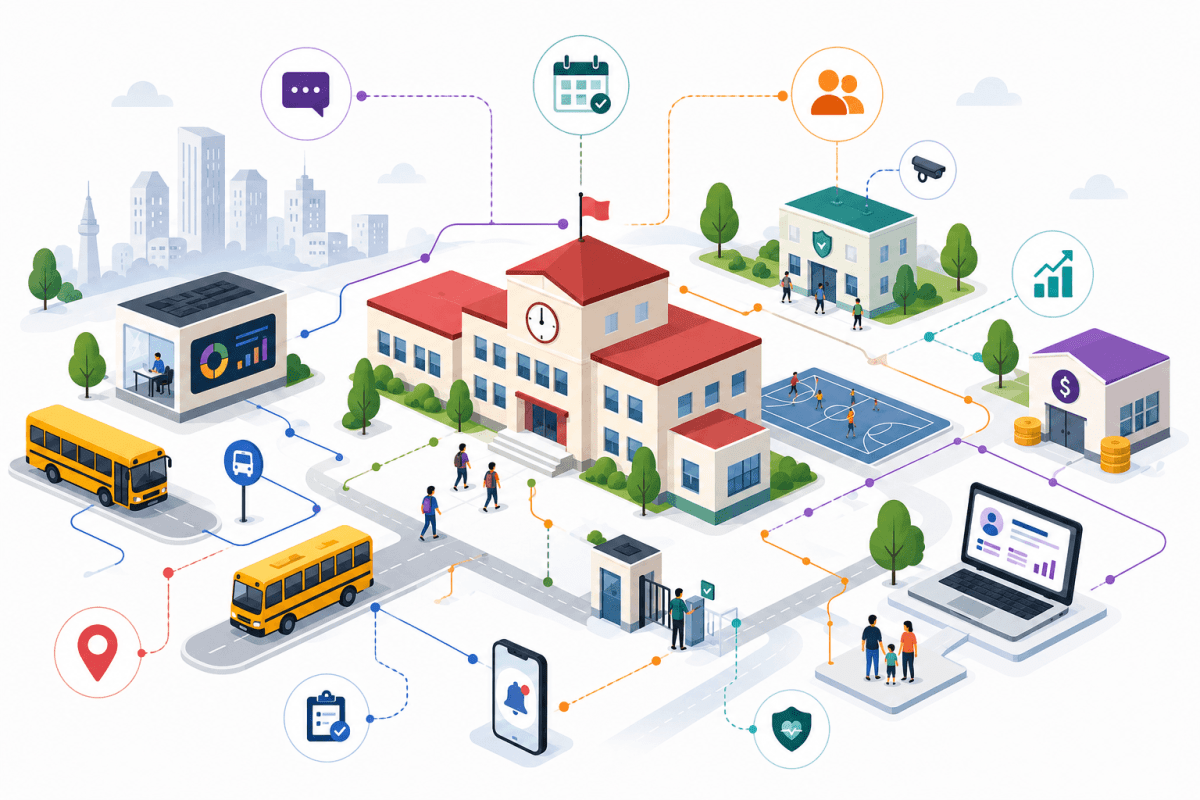
The Hidden Infrastructure Behind Every School Day
Every morning, a small city wakes up.
Buses arrive in waves. Gates open. Messages begin moving between hundreds, sometimes thousands, of people. Attendance is recorded. Lunches are prepared. Timetables coordinate movement across buildings. Emergencies are managed quietly in the background.
By 8:00 AM, a modern school has already handled logistics, communication, scheduling, security, transport, wellbeing, administration, and finance, all before the first lesson properly begins.
Yet schools are rarely thought of in this way.
We think of them as places of learning. And they are. But behind every classroom is a complex operational ecosystem working constantly to keep the day moving. The truth is, schools don’t just educate.
They function remarkably like small cities.

A School Runs on Movement
Think about the average school morning.
Students arrive from different locations, using different forms of transport, within carefully managed time windows. Staff coordinate supervision duties. Reception teams manage visitors. Attendance systems confirm who is present and who is missing.
It’s not very different from urban flow management.
When movement systems fail in cities, congestion appears. Delays ripple outward. Communication breaks down.
Schools experience the same thing.
A late bus can affect classroom schedules. Poor communication can disrupt parent pickup procedures. In tightly connected environments, small gaps rarely stay small for long.
Behind the rhythm of an ordinary school day is an enormous amount of invisible coordination.
And the larger the school becomes, the more important coordination becomes.
Schools Depend on Invisible Infrastructure
Cities rely on infrastructure that people rarely notice until something stops working.
Traffic systems. Utilities. Communication networks.
Schools are no different.
Behind every smooth school day is an invisible framework managing:
- student information
- staff coordination
- parent communication
- finance and billing
- attendance tracking
- timetable structures
- reporting systems
- wellbeing records
When these systems are disconnected, schools begin creating what many administrators quietly recognise: operational friction.
The same information gets captured multiple times. Staff rely on side spreadsheets. Parents receive inconsistent communication. Departments operate in silos.
Eventually, the workload becomes heavier not because schools are failing, but because the systems surrounding them are fragmented.
This is one of the biggest shifts happening in education today.
Schools are no longer just managing education.
They are managing complexity.

This is one of the biggest shifts happening in education today. Schools are no longer just managing education.
They are managing complexity.
The Human Side of School Operations
What makes schools different from most organisations is that they manage both logistics and emotion simultaneously.
A city may manage traffic flow.
A school manages:
- learning
- uncertainty
- communication
- student wellbeing
- family expectations
- emotional pressure
- community trust
Every operational decision ultimately affects people.
A delayed message to a parent.
A timetable conflict.
A missed attendance alert.
Small operational gaps can quickly become human problems.
That’s why modern school management is no longer just about administration. It’s about creating connected environments where information moves clearly, quickly, and responsibly.

Why Modern Schools Need Connected Systems
As schools grow more digitally connected, expectations grow with them.
Parents expect real-time communication. Leadership teams need clearer reporting. Staff need fewer repetitive admin tasks. Students benefit from faster support systems and more organised learning environments.
But adding more disconnected tools rarely solves the problem.
In many cases, it creates more noise.
The challenge facing schools today is not simply digitisation.
It’s coordination.
That’s where integrated school management platforms are becoming increasingly important.
As schools become more connected, the challenge is no longer simply accessing information. It’s making sure information moves clearly between the people and systems that rely on it every day.
Attendance affects well-being. Communication affects trust. Reporting affects decision-making. None of these systems operates in isolation anymore.
That’s why many schools are moving away from disconnected tools and toward more unified ecosystems, where information flows more naturally across departments, staff, parents, and leadership teams.

Platforms like Ed-admin are part of this shift, helping schools reduce operational friction and create more connected day-to-day experiences for the people inside them.
The Future School Will Feel More Connected
The schools evolving most successfully today are not necessarily the ones with the most technology.
They are the ones where systems, people, and information work together naturally.
Where`:
- Communication is clear
- Reporting is accessible
- Workflows are streamlined
- Parents stay informed
- Staff spend less time chasing information
- Leadership teams can make decisions with confidence
In many ways, the future school may look less like a collection of separate departments and more like a connected living system.
A small city, designed around learning.
And just like cities, the schools that thrive will be the ones built on infrastructure people can trust.

Connected schools are not built through more platforms, more notifications, or more complexity. They are built through systems that help information move clearly among the people who rely on it every day. If your school is exploring what digital maturity could look like in practice, book a demo with us to see how Ed-admin supports more connected operations across communication, reporting, administration, and day-to-day school management.